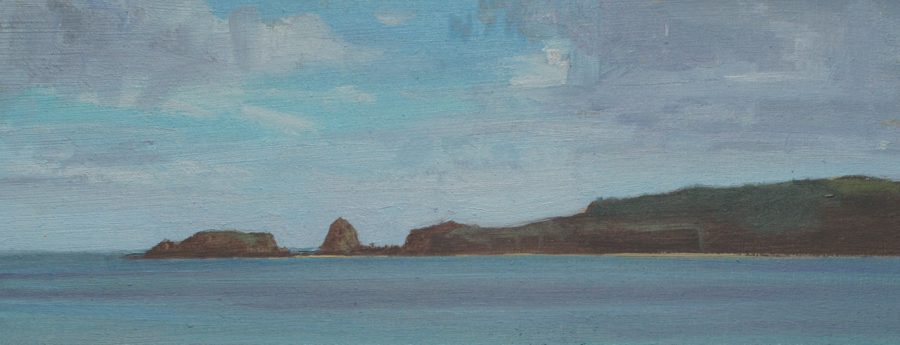
I have just returned from a 10 day painting trip to the wonderful Pembrokeshire Coast National Park in Wales. The weather ranged from wet and windy to glorious sunshine. I was able to get useful work done everyday, returning with more than 30 pictures, although I will only frame a fraction of these. Here are four of the smallest paintings from the trip. They are all in oil on board and measure 10 x 25 cm or 4 x 10 inches. As usual they were all completed on the spot.
You can click each of them to view the full size image or why not try out the slideshow link below. To return to this page from the Piclens viewer click on the link at the top left.
I am busy this week collecting frames and delivering paintings to different exhibitions but I will post more paintings of the Pembrokeshire coast as I get organised.
One thing you become accustomed to when painting outside is having your photo taken. This great black and white photograph was kindly emailed to me by talented photographer Magdalena Rakita.
I am frequently asked for advice on painting outside, sometimes by beginners, but often by quite accomplished studio painters. The following tips are replies to questions I have been asked recently.
How do you deal with people watching, negative comments or groups of teenagers? I will be painting in the centre of town!
Most people won’t even notice you! Those that do generally don’t stop for very long, its usually a quick glance and they carry on walking. You will get very few negative comments – I get, perhaps, one a year. I think your own personality will determine to what extent you talk to or ignore people when you are working. As for groups of teenagers, I find that they generally impressed with what you are doing. Its quite cool to be an artist.
Do you find that you sell a lot more work due to the interest in your painting on site ?
I have been invited to show in galleries and exhibitions by people who have seen me painting outside.
Have you any tips you can give me about setting up etc ?
It can be a bit nerve-racking the first time you set up in public but just go for it. Set your gear up and look as though you’ve done it for years – no one know’s any different.
If you are in London I would suggest setting up half-way across Waterloo Bridge. You will find that, as most people crossing the bridge are going somewhere, they won’t stop to bother you and you will quickly get used to people being around while you are working. It sounds like an ‘in at the deep end’ approach but most people will completely ignore you. If you set up outside a pub on a sunny afternoon the drinkers will have plenty of time to stand around and make helpful suggestions.
Some artists try to hide away completely when they work outside, but you probably won’t get the best view point. Be brave and choose your location to give you the best picture. I am quite happy to set up my box easel outside the National Gallery overlooking Trafalgar Square (photo above) or on the South Bank on a busy afternoon.
I use a half box easel with a good padded shoulder strap. I think a full box easel is likely to discourage you from walking very far.
Everything I need goes into one bag, it contains:
6-8 boards in different sizes
a box to carry the wet panels
Low odour white spirit
a small jam jar with lid for cleaning brushes
rags
brushes
T-square, useful for straight edges especially the horizon in seascapes
food and drink, hat, gloves etc
One important difference you will notice when painting outside, compared to in a studio, is how fast everything changes. Work small and don’t spend more than 2 hours at a time on a picture. Ideally 1 1/2 hours is about right or the shadows/weather/tide etc will have changed too much and you end up with one picture painted over another. You can always go back another day but in the UK you will be lucky if the light is the same for two days in a row.
If you have any questions or tips to add please leave a comment.
Here is one of my recently completed paintings. It was painted over three days in March 2009 on the river front at Richmond in Surrey. Most of the work was done on the first two days and on the third day I was just making a few corrections. The picture was allowed to dry between painting sessions.
As most of my pictures are painted in ‘one wet’, it was quite a luxury this time to be able to work over dry paint. One of the things I enoy about painting a picture like this one is the challenge of painting the people (staffage). They are all painted from life and, obviously, it is easier when they come and sit by the river than when they just walk by. In which case I will often mark the position of their head and feet to fix their size on the canvas and adjust the scale as they walk away – diminishing in size. And as for those who cycled past – well – I’ll just pretend I didn’t see them.
It is oil on board and measures 10 x 20 inches (25.5 x 51cm).
I have just returned from a very wet and windy week painting in Pembrokeshire, south west Wales. The coastline here is stunningly beautiful with long sandy beaches and rugged cliffs. Despite the wild weather I got plenty of painting done, much of it while sheltering behind the open tailgate of my car. The picture above is 8 x 36 inches (approx. 20 x 90 cm) and was painted with the easel resting in the boot. To see the painting in more detail, click on the image below.
Seal by the River Rother at RyeLast week I was in Kent to collect some new hand-made frames and went down to Rye to paint with friends Karl Terry and Chris Daynes.
We spotted this seal on the banks of the river. He (or she) was not at all bothered by our presence and stayed there for the afternoon while we worked nearby – even being included in one of my paintings.
Painting in the Chiltern HillsLast month’s snow was a gift to landscape painters. As I have been painting outside throughout the winter, it was good to see a snowy landscape at last.
This is my typical set up when painting out on location. I use a half box French easel to hold the small boards or larger canvases. The drawer of the easel stores my paints and the folding palette fits on top of the open drawer.
Everything I need – boards, brushes, palette knives, thinners, rags, storage box for wet paintings and, most importantly, my lunch – goes in the bag.